Our clients make big, bold moves every day. Clients that are expanding their footprints, shaping cities and suburbs, pioneering new ways to inspire customers and grow their businesses. In a challenging market, how are these opportunities crystallising?
Population Growth
In the last year, Australia grew by almost 484,000 persons or 1.8%, still above the pre-COVID growth rate of around 350,000 to 400,000 persons (1.4%). Although falling due to lower immigration levels, the annual rate of growth is still planned at 350,000 to 400,000 persons over the next 20 years, with the population tracking to over 36 million by 2046 (an additional 8.2 million people). The bulk of the additional growth is still planned on the eastern seaboard, accounting for over 80% of the growth.
Retail Development
Maintaining an ideal benchmark of 2.3 sq.m of retail floorspace per Australian means we should be building / adding 800,000-900,000 square metres of new retail floorspace each year. These levels have not, however, been achieved in any year since pre-GFC (2008). Put another way, one supermarket for every 10,000 persons means building 40 new stores each year yet in reality less than 20 new major supermarkets are being constructed nationally at the moment.
So, why are we not building space? The opportunities seem obvious, however, online retailing capturing a greater share of the market and increasing construction costs (most relevant now), make it very difficult for developments to be viable. Lastly, the lack of appetite for new stores from major non-food tenants (department stores and discount department stores) leaves major shopping centre owners with limited options. These factors all cloud the horizon for a turbo boost / kick up in retail development.
Mixed Use Development
That brings the shopping centre industry back to mixed use development. While office development is currently less viable, medical hubs, Build to Rent (BTR) and Build to Sell (BTS) are all being master-planned by major shopping centre owners to boost returns. With an increasing population, it’s a theoretical no-brainer. Construction costs and a myriad of planning regulations are, however, impacting on the ability to deliver multiple dwelling residential projects quickly. Major shopping centres comprising a mix of uses, however, is now more important than ever, driving customers to centres for a range of reasons.
The Consumer
Consumer confidence levels have been at historic lows post-COVID, with cost of living pressures felt across the nation. With interest rates predicted to fall rapidly in the next twelve months, and house prices remaining elevated, the consumer is now starting to open their wallets with a higher level of disposable income. Retail needs to maintain a share of this increased spending. Over the next 12 months, retail sales should remain positive, albeit still at levels around 3%-4%.
Where does that leave us?
With population growth so rapid, and multiple dwelling residential development stalling, our outer suburbs are being super charged in the short term. The ability to deliver detached dwellings or townhouses is more flexible than multi-storey development, so that from Ripley, Greenbank, Flagstone and Aura in the Sunshine Coast, housing development is continuing at pace, but with essential infrastructure such as shopping centres lagging demand. Jump in your car and have a good look around our growth areas. The activity is fascinating.
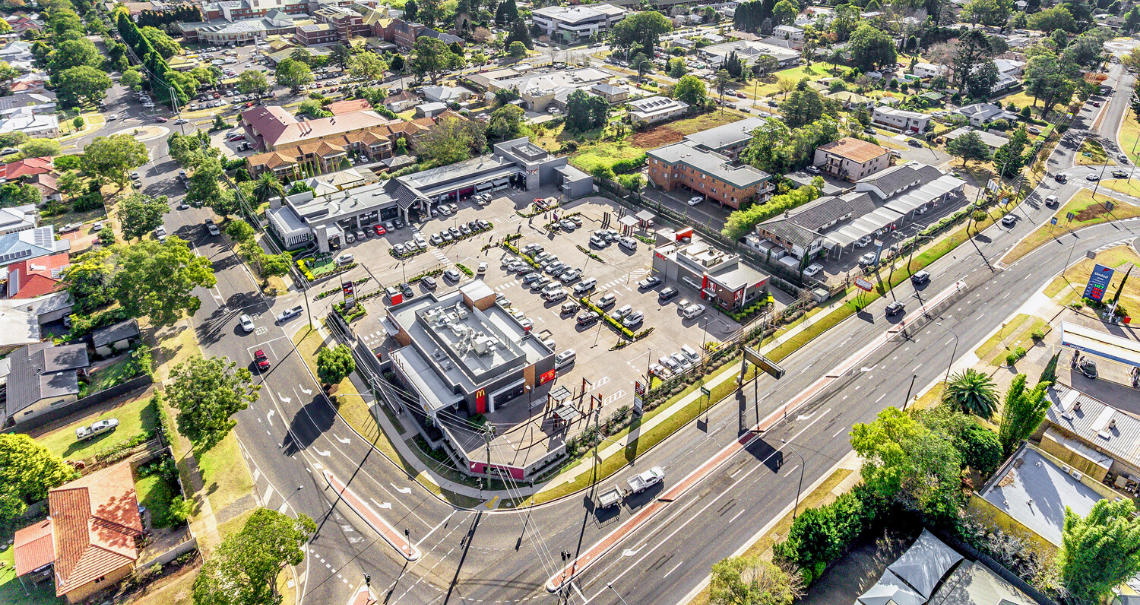
Supermarket centres are still being demanded in the growth areas with a range of investment grade assets across taverns, storage, childcare, fast food and service stations. Specialty shop numbers are increasing for new neighbourhood centres due to the lack of development for regional and sub-regional centres.
In the medium term, we cannot continue to grow without higher density living. At some stage, this form of development will provide housing options for a rapidly expanding population. With greater density will come benefits for strategically located regional centres – close to schools, workplaces and public transport. Given replacement costs for most retail assets are well above existing values, the attractiveness of existing centres will increase over time.
Some sub-regional shopping centres will remain attractive propositions, although watching for discount department stores that rolled over on short term leases during COVID. The opportunities to backfill discount department stores which vacate centres will require some specialised management.
Given the current flux in the economic outlook, shopping centre ownership is not for the faint hearted but there are still opportunities for Australia’s retail and property communities to make big location decisions. The commitment from major retailers, particularly the supermarket chains and mini-major tenants, to serve our growing population will drive demand for centres in outer growth suburbs in the short term, and higher density precincts in established inner and middle ring suburbs beyond that.
Some Industry Changes
As a side note there are some major administrative changes occurring in the industry. Firstly, the ABS retail trade series is being discontinued after the June 2025 release. It’s being replaced by the Monthly Household Spending indicator. We will wait and see what this change brings.
Secondly, the ACCC will start a new mandatory merger control regime for notifying and assessing acquisitions on 1 January 2026. Under the mandatory merger control regime, businesses contemplating an acquisition that meets certain thresholds must notify the ACCC and wait for approval before their proposed acquisition can proceed. This new regime will spread a wider net that just supermarkets that have been the focus of the ACCC in recent years.
As always, nothing remains the same. Managing and developing shopping centres requires specialist skill and advice.
Reach out to Gavin Duane on:
0409 216 452
Location IQ is a location intelligence advisory firm that simplifies complex data to guide property decisions. They offer unmatched expertise in the Australian market, serving clients like Woolworths, Dexus, Vicinity Centres, Lendlease, Stockland, GPT Group, and private developers. Their research pinpoints high-demand areas across sectors, helping businesses choose the most strategic and profitable locations.